Blog
Content
Modern retailing: the ancillary layer for payments and distribution
Hotels are ready to move beyond room-only selling. Modern retailing gives guests more choice and helps capture more spend, but it requires infrastructure that connects distribution, payments, and reconciliation.

Kenzie Dolfo-Smith
Product Manager
Airlines proved the model first.
What began as a way to sell bags, seats, meals, and priority boarding has become one of the most profitable parts of air travel. In 2024, airlines generated an estimated $148.4 billion in ancillary revenue, representing nearly 15% of total airline revenue.
Hotels have the same opportunity.
Guests do not only buy rooms. They buy better arrival times, better views, breakfast, parking, spa access, meeting space, airport transfers, and the ability to shape a stay around their needs.
Yet hospitality still sells too much of the guest experience as if the room is the only product.
That is starting to change. Hotel ancillary revenue is moving from a side category to a core commercial strategy.
One estimate places the global hotel ancillary revenue platform market at $4.8 billion in 2025, with expected growth to $11.2 billion by 2034. Wyndham also reported that ancillary revenue increased 18% year over year in the third quarter of 2025.
The direction is clear: the next phase of hotel growth will not come only from selling more rooms. It will come from selling the stay more intelligently.
From room selling to stay selling
Modern retailing is the shift from selling a room to selling a complete stay.
Instead of offering a rate, a room type, and a few static booking conditions, hotels can expose the property's full commercial value within the booking flow.
Whether selling on a brand.com or app or through a partner (via direct distribution), options can be merchandised to guests at the moment they’re most likely to make a decision.
This includes:
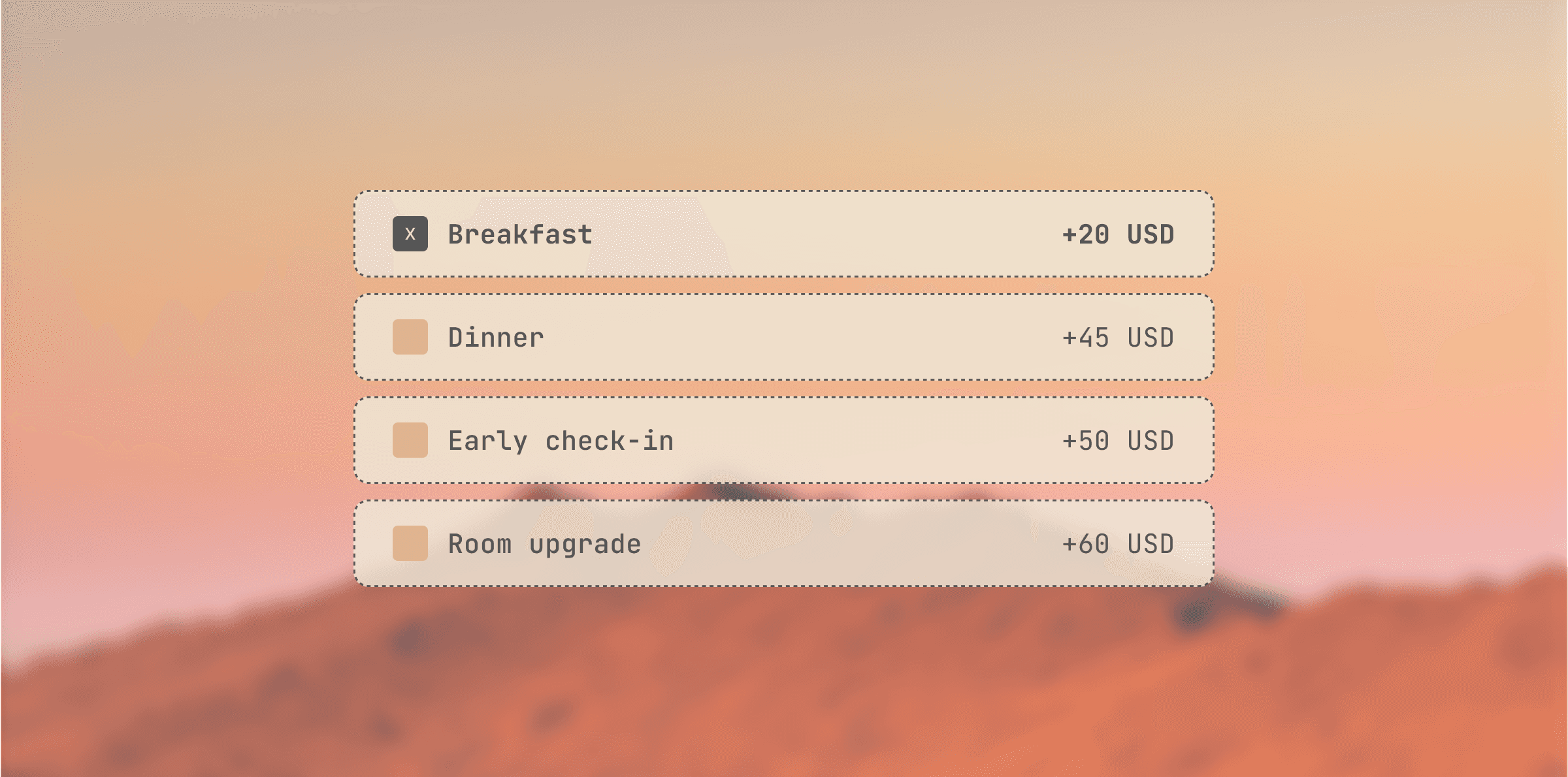
Room upgrades, views, bed types, and accessibility features
Early check-in, late check-out, and flexible stay extensions
Breakfast, dining, full-board, and food and beverage packages
Parking, airport transfers, and local mobility
Spa, gym, coworking, and meeting facilities
In-destination services, local experiences, and packages
These are not minor extras. They are revenue opportunities that already exist inside the property but are often sold too late, too manually, or not at all.
For travel agents, this creates a better booking experience. Guests can shape their trip before they arrive, rather than discovering options at the front desk or across disconnected channels.
For hotels, it creates a more complete commercial model. Revenue is no longer limited to the base room rate. More of the stay is monetized before arrival, with clearer intent and cleaner data.
Why the timing matters
Hospitality margins are under pressure.
Distribution costs remain high. Payment costs remain fragmented. Guest expectations keep rising. At the same time, guests are increasingly accustomed to digital journeys in which products are configurable, personalized, and easy to purchase.
The old booking flow does not match today’s reality.
When add-ons are handled separately from the booking, several problems appear:
Guests miss relevant options.
Hotels lose revenue opportunities.
Travel agents lose share of wallet.
Operational teams handle requests manually.
Payments and reconciliation become harder than they need to be.
Modern retailing solves a commercial problem, but it also exposes an infrastructure problem.
To sell a stay properly, travel agents need access to structured products, real-time availability, consistent pricing, booking rules, payment logic, and post-booking flexibility. That cannot be solved with static content or disconnected integrations.
It requires infrastructure.
The infrastructure gap in hotel ancillaries
Hospitality has not failed to scale ancillary retailing because demand is missing.
It has failed because the underlying systems are fragmented.
Hotels expose ancillary products in different ways. Property management systems, central reservation systems, booking engines, and channel managers each handle content and availability differently. Many systems were built to distribute rooms, not to merchandise a flexible stay.
The result is inconsistency.
A travel agent may be able to sell breakfast at one property but not at another. A late check-out option may be available in one system, but not exposed through the travel agent’s booking flow.
A room attribute such as view, bed type, or accessibility may exist at the hotel level, but disappear once it moves through legacy distribution.
This is where modern retailing breaks down.
A guest cannot buy what the system cannot display. A travel agent cannot merchandise what the hotel cannot expose consistently. A hotel cannot scale ancillary revenue if every partner requires a separate integration, workflow, or reconciliation process.
Why travel agents should care
For travel agents, ancillary retailing is not only a hotel revenue story.
It is a distribution opportunity.
When travel agents bring more of the stay into the booking flow, they create a more valuable transaction. They increase revenue per booking, improve the guest experience, and capture spend that would otherwise move to another channel.
The benefits are direct:
Increased booking value without additional demand generation
Better conversion through a more complete booking experience
Stronger retention because guests can plan more in one place
Higher share of trip spend captured at the point of sale
More structured data for personalization and AI-driven booking flows
This matters even more as booking behavior changes.
Katanox has already written about the infrastructure needed for agentic commerce, where the winning platforms will not simply inspire guests, but complete the transaction from search to settlement. In that environment, ancillary retailing becomes even more important.
AI-driven booking flows will need structured, bookable, and payable products. Not just room descriptions.
Modern retailing offers more to sell. Infrastructure determines whether they can actually sell it.
How Katanox enables modern retailing
Katanox provides the financial infrastructure for hospitality commerce.
That matters because ancillary retailing does not stop at product discovery. It has to connect to booking, payment, reconciliation, and post-booking changes.
Katanox enables this through a single, agnostic platform that standardizes the way travel agents access hotel inventory, rates, content, and commercial products.
Instead of building separate integrations for each partnership, travel agents connect via one API and manage partners through a single layer.
That creates three core advantages.
1. A single implementation for fragmented supply
Hotel supply is fragmented by nature.
Different suppliers use different systems, commercial rules, content structures, and workflows. Katanox abstracts that complexity into a single platform, making it easier for travel agents to access and sell more of the hotel experience across their supplier base.
Early check-in, breakfast, parking, and upgrades can be handled through a consistent commercial layer rather than custom one-off workflows.
This reduces implementation complexity and makes ancillary retailing more scalable.
2. Structured data for better merchandising
Modern retailing depends on structured data.
A guest choosing between “standard room” and “deluxe room” is not really (personalized) shopping. A guest choosing a higher floor, a specific bed type, a sea view, breakfast, and a late check-out is building a stay.
Katanox helps preserve and standardize the structured information needed for that experience.
This includes room attributes, amenities, policies, and commercial options that legacy distribution can flatten or strip away. Better structure enables better merchandising, clearer personalization, and more reliable AI-driven booking flows.
3. Payments and reconciliation built into the transaction
Ancillary retailing creates more transaction complexity.
More products mean more pricing logic, more payment lines, more commission rules, more cancellations, and more reconciliation work.
If payment and distribution are disconnected, ancillary growth can create operational drag.
Katanox is built around the opposite idea: bookings and funds should move through the same infrastructure. By connecting distribution, payments, and reconciliation, Katanox makes it easier to sell more without adding manual work after the transaction.
That is the difference between adding more products and building a scalable retailing model.
The next layer of hospitality commerce
The hotel industry does not need to copy airlines exactly.
Hospitality is more complex, more fragmented, and more service-driven. A hotel stay is not a seat on a plane. It is a flexible combination of space, timing, service, location, experience, and payment terms.
That is precisely why the opportunity is so large.
Modern retailing gives hotels and travel agents a way to sell the full value of the stay. Ancillaries and add-ons become part of the core booking journey, not disconnected extras.
Guests get more control, travel agents capture more spend, and hotels monetize more of what they already provide.
The limiting factor is no longer demand.
It is infrastructure.
Katanox provides the layer that connects hotel distribution and payments, so travel agents can move beyond room-only selling and build the next generation of hospitality commerce.
Kenzie Dolfo-Smith
Product Manager
Share

