Blog
Content
Katanox Capital: Redefining how hospitality moves money
Katanox Capital embeds liquidity into hospitality payments, giving hotels guaranteed payouts and letting travel agents settle monthly with less friction.

Mendel Senf
Co-founder & CEO
Across the hospitality industry, a structural mismatch has persisted for decades: commercial value is created long before money reliably moves.
Hotels deliver inventory, absorb operational risk, and operate on narrow margins, yet they often receive funds late, unpredictably, and at disproportionate cost.
Travel agents and corporate buyers, meanwhile, are required to pre-finance bookings, tying up liquidity well in advance of revenue realization.
The financial plumbing underpinning the industry was not built to reflect the economic realities of hospitality, where bookings, cancellation policies, revenue recognition, invoicing, and settlement timing are inseparable.
According to industry research, 66% of travel companies report that outdated payment systems are eroding their margins, and nearly 90% prioritize upgrading their financial operations to remain competitive.
Payment fragmentation slows reconciliation, increases manual workload, and obscures financial visibility. Many organizations still process settlements in bulk or on an ad hoc basis, disconnected from the underlying booking lifecycle. This delays decision-making, complicates accounting, and reduces strategic flexibility.
Katanox Capital is built on the premise that these problems are not the result of insufficient optimization, but of a flawed foundation.
Rather than optimizing isolated components of a broken system, Katanox has re-engineered the infrastructure itself, embedding liquidity directly into the money flow to realign incentives across the ecosystem.
Why the legacy system no longer works
The existing B2B hospitality payments model relies heavily on infrastructure originally developed for consumer transactions.
Payment rails built around credit and debit cards — and later adapted to virtual equivalents — were never constructed to handle the complexity of hospitality economics, where bookings, cancellation policies, revenue materialization, and payout logic are tightly intertwined.
Legacy payment systems force hotels to trade margin and certainty for access to distribution. Fees accumulate across card networks, processors, issuers, and intermediaries, while settlement timelines remain opaque and reconciliation labor-intensive.
At the same time, corporate buyers and travel agents are incentivized to push payment risk downstream, locking capital into deposits, guarantees, or prepayments that constrain growth.
This disconnect is not merely an operational inconvenience; it has strategic consequences. Research finds that over 90% of travel companies do not see clear growth opportunities with current payment methods, while nearly all respondents acknowledge that inefficiencies waste resources and time on activities unrelated to core business value creation.
Today, payment processors, card networks, and issuers extract fees that typically range from 2% to 4% of transaction value, and even higher when disputes, FX, and operational overhead are included, consuming a material slice of already-thin margins.
Yet despite those costs, hotels often wait days or weeks to receive funds, and reconciliation remains complex and error-prone, all while bearing the burden of this suboptimal payment network.
Hotels pay the highest fees, handle front-desk friction, manage reconciliation, and shoulder dispute risk even though they receive funds last. The players who benefit most from the network do not bear its economic burden.
Fragmentation also undermines trust. When partners are not paid promptly or accurately, they may demand prepayments or refuse to enter into future partnerships, creating a cycle of collateral requirements that further strains working capital.
The divide between payments and distribution
At the heart of the problem is a longstanding separation between the technology that drives distribution and the systems that handle financial flows.
Distribution platforms are optimized for sourcing inventory, managing rates, and confirming bookings. Meanwhile, payment networks focus on moving money between parties once a transaction is agreed upon.
These functions evolved in parallel, shaped by different incentives and historical legacies, but with little structural connection between them.
As a result, payments have effectively been bolted onto the booking process after it has occurred. Financial reconciliation, risk evaluation, and money movement are handled by different systems, often mediated by a tangle of third‑party processors, networks, and intermediaries that lack full visibility into the booking context and the ability to act on it.
This fragmentation produces predictable friction:
Hotels often wait weeks for confirmation and receipt of payouts.
Travel agents lock up capital in advance of settlement.
Back‑office teams spend significant time on manual reconciliation.
Payments become a constraint rather than a source of utility, impeding growth and innovation.
Why Katanox’s approach is different
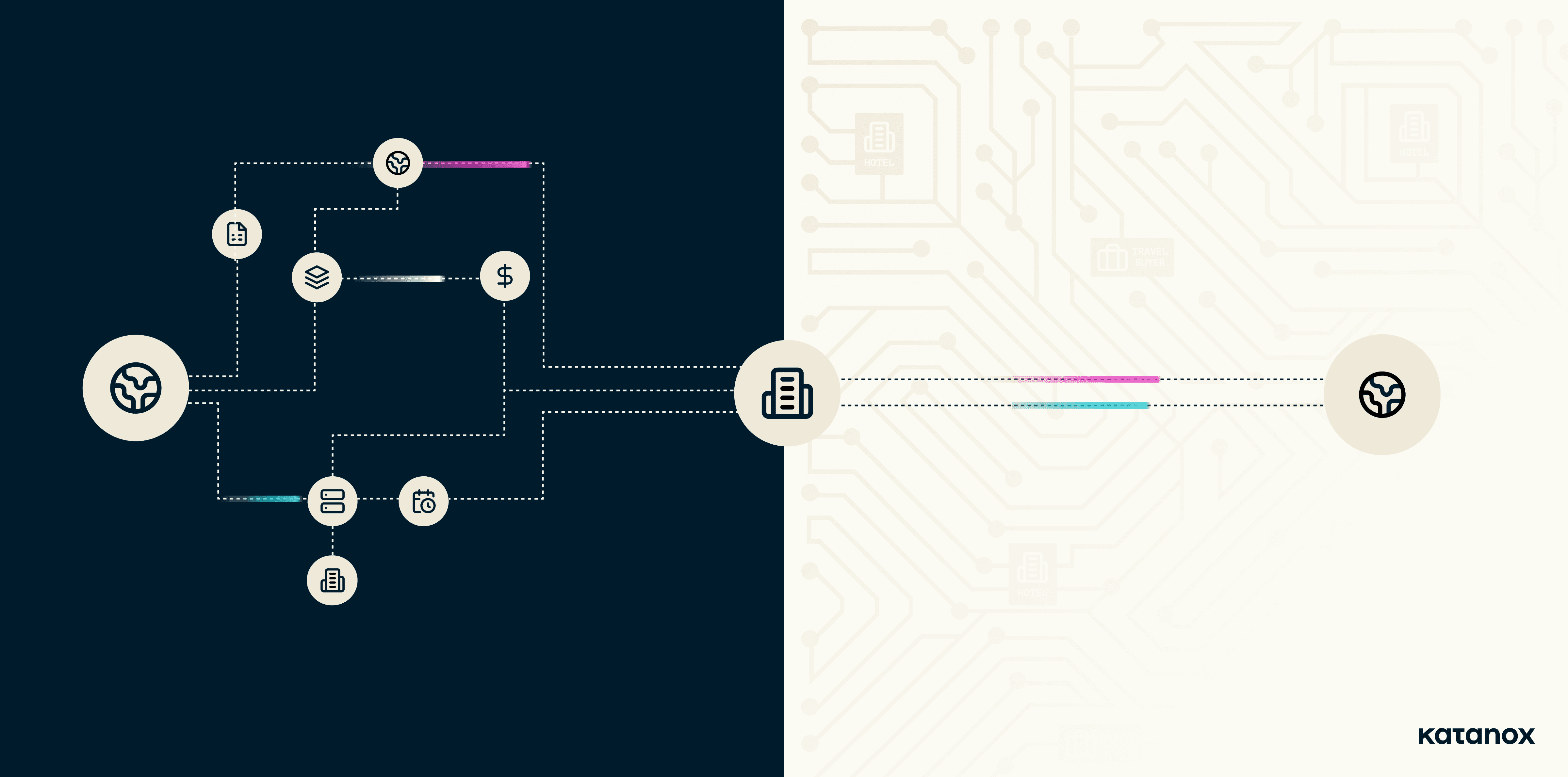
Katanox Capital remedies this by unifying what historically has been kept apart: the flow of bookings and the flow of funds.
By controlling the booking lifecycle end‑to‑end — from distribution to payment orchestration and final accounting — Katanox has a complete view of the conditions under which a transaction becomes financially definitive.
Rather than layering financing on top of payment rails that were never designed for the hospitality industry, Katanox Capital derives liquidity from certainty.
In practical terms, once a booking reaches its financial trigger — such as booking a non-refundable rate or at guest check-in — settlement is guaranteed, and funds are automatically transferred from account to account.
Here’s an example of how Katanox Capital works:
Upon booking materialization, a payment guarantee to the hotel and a commission guarantee to the travel agent are triggered.
Katanox Capital advances payment to the hotel and pays the travel agent's commission in daily batches.
The travel agent settles all advanced transactions, including applicable fees, monthly via account-to-account payments.
Because the system understands both the commercial and financial contexts, it can align payouts, reconciliations, and capital in ways traditional intermediaries cannot.
This unified view solves not just the symptoms of the payments problem, but its root cause — the disconnect between the commerce system and the financial system that supports it.
Real benefits for hotels and travel agents
For hotels, this model reshapes their financial experience. Instead of waiting for cashflow cycles dictated by third‑party processors, they receive timely, predictable payouts directly into their bank accounts.
Hotels receive a non-reversible payout guarantee the moment a booking materializes. Payments are settled account-to-account and delivered in predictable daily batches.
They also avoid the layered costs of card networks and intermediaries—an economic shift from paying others to participate in a legacy network to receiving fair value aligned with their own risk and performance.
Travel agents and corporates also benefit materially. Instead of pre-funding bookings or reconciling thousands of individual card transactions, agents settle with Katanox on a consolidated monthly basis with transparent reporting and predictable costs.
Katanox Capital is embedded in the booking flow, so only guaranteed bookings count toward settlement exposure. Capital is not tied up in flexible or speculative reservations, allowing agents to grow without wasting liquidity.
This approach inherently reduces operational overhead and allows reinvestment of capital into growth rather than liquidity management.
Infrastructure over workaround
The hospitality sector is at an inflection point. As global payments become more complex and booking volumes grow, the costs of legacy systems are becoming too high to ignore.
Research shows that inefficient payment processes are widely seen as a constraint on profitability, with executives prioritizing financial system upgrades.
Katanox Capital’s model marks a departure from incremental optimization toward foundational redesign. By unifying payment and distribution systems, aligning economic incentives, and embedding liquidity at the point of business value creation, it reframes financial operations as infrastructure rather than overhead.
As more hotels, travel agents, and financial institutions adopt this model, the industry may finally move past the limitations of card‑based B2B payments toward a more efficient, transparent, and scalable financial foundation.
This is not disruption, but infrastructure that will power hospitality for decades to come.
About Katanox Capital
Katanox Capital provides settlement and liquidity infrastructure purpose-built for the hospitality industry, aligning booking certainty with guaranteed account-to-account payments.
Hotel groups and accommodation providers interested in modernizing their settlement processes, reducing payment costs, and accelerating payouts can contact Paul Beukers.
Banks, financial institutions, and capital providers interested in deploying capital to support settlement and liquidity flows within the Katanox ecosystem can contact Mendel Senf.
Mendel Senf
Co-founder & CEO
Share