Blog
Company updates
How Katanox frees up trapped working capital in hospitality
Instead of treating every reservation the same, Katanox allocates capital based on guaranteed bookings, freeing up working capital that would otherwise be locked up in refundable inventory.

Imre Vogelezang
Co-founder & CPO
Travel agents and corporate (travel) buyers often have to commit cash before revenue arrives. Inventory must be secured, suppliers (hotel) paid, and bookings confirmed well ahead of guest arrival and settlement. As a result, investment consistently precedes earnings.
This really helps buyers who are near their capital limits: smaller agents or smaller corporates (SMBs).
To keep selling and scaling, travel agents and corporate buyers need a way to bridge that timing gap without waiting for payments to clear. This is not just a finance problem. It is an operating constraint that impacts growth.
This is precisely why we developed Katanox Capital: a settlement and liquidity infrastructure purpose-built for hospitality that unifies the booking lifecycle with the flow of funds, so money moves when commercial value becomes certain (for example, when a booking becomes non-refundable or at check-in).
It delivers guaranteed, non-reversible payouts to hotels in predictable daily batches, while travel agents and corporate buyers avoid pre-funding by settling advanced transactions on a consolidated monthly basis.
While this article is a feature deep dive into dynamic exposure (more on that below), we suggest reading our more general article outlining Katanox Capital first.
The problem: working capital gets trapped by legacy complexity
In hospitality, traditional capital and payment setups (such as virtual credit cards [VCCs]) are often too rigid for how travel is actually booked today.
They treat every reservation as a firm obligation, even when a large share of bookings can be canceled or changed weeks or months in advance, or don’t materialize until a future settlement cycle.
That rigidity creates two common pain points:
Capital is consumed too early by flexible inventory, reducing purchasing power for bookings that are truly likely to materialize soon.
Risk is misallocated: either the travel agent or corporate buyer borrows too early (wasting capital), or the supplier (the hotel) is left exposed to non-payment.
Industry research on treasury and money movement points to the same root cause: fragmentation across providers slows cash movement, reduces visibility, and traps liquidity in transit.
Why is this getting harder?
As digital expectations move toward real-time experiences, money is expected to move faster, too. In travel specifically, liquidity risk increases when inflows are complex and delayed, while outflows can be immediate and span multiple currencies, geographies, and settlement timelines.
This mismatch compels businesses to keep larger buffers, reducing flexibility for liquidity decisions and limiting opportunities to (re)invest in other areas. This particularly affects smaller or growing companies, which often face capital constraints.
Katanox Capital: dynamic exposure based on real booking conditions
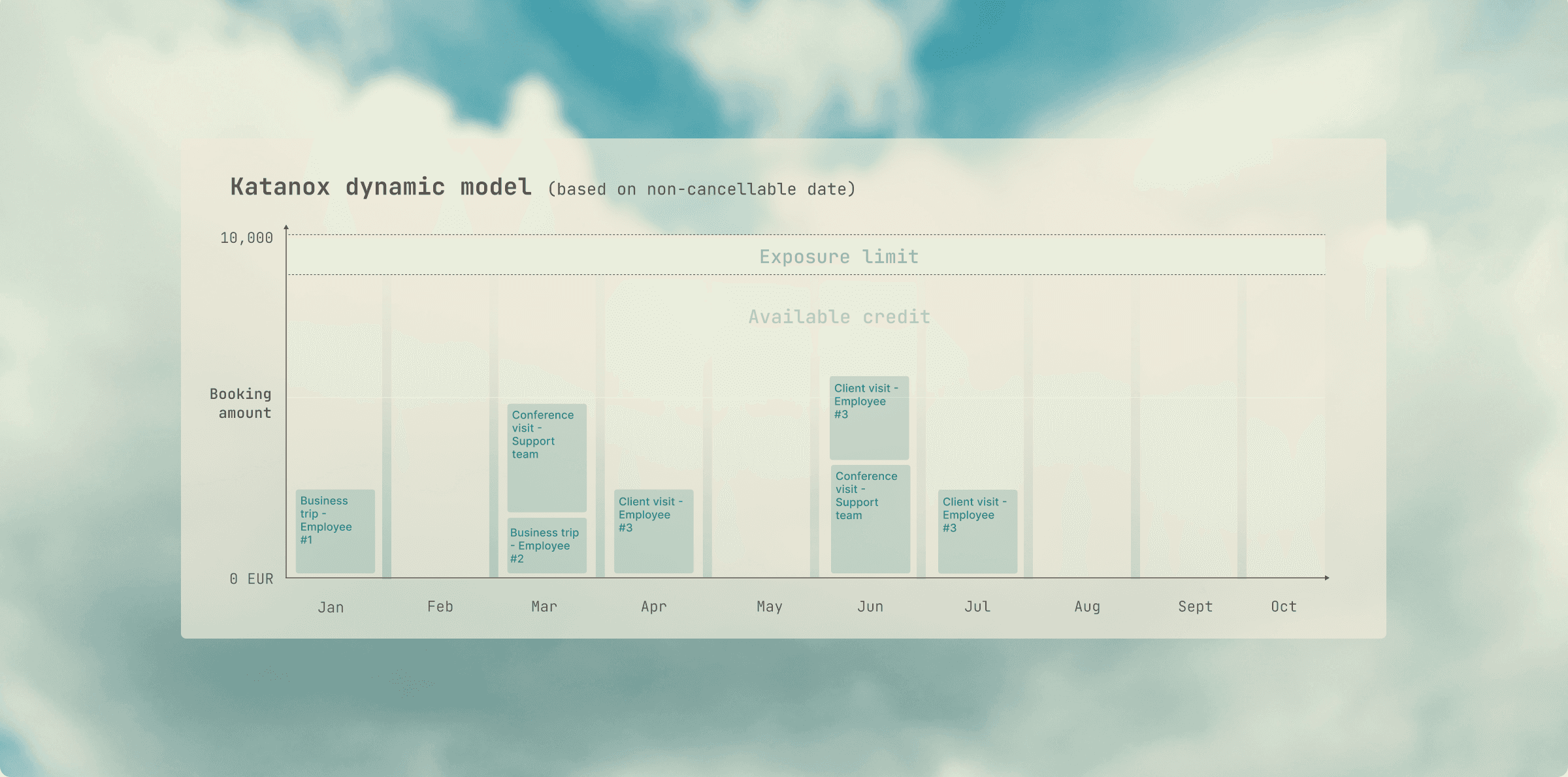
Katanox Capital solves this by underwriting booking-level risk using real-time booking policy data. Instead of treating every reservation the same, Katanox allocates capital based on the actual commitments.
Katanox does this through dynamic exposure:
Guaranteed bookings count toward a buyer’s capital allocation.
Flexible bookings do not restrict available capital until they clear and become non-cancellable.
This frees up working capital that would otherwise be locked up in refundable inventory while preserving operational control.
Because Katanox integrates directly into the booking flow, it maintains continuous visibility into which reservations are refundable and which are non-cancellable. This supports two clear calculations:
Gross exposure: total value of all reservations
Recoverable exposure: value tied up in reservations that can still be canceled
Actual exposure = Gross exposure − Recoverable exposure
For example, if a travel agent uses €100,000 to secure 1,000 reservations at €100 each, and 600 are still cancellable, Katanox recognizes that only €40,000 is truly committed.
The remaining €60,000 is recoverable and available for other bookings.
This aligns capital with actual obligations rather than theoretical limits, improving liquidity and operational clarity.
Daily, forward-looking capital management (365-day simulation)
Katanox continuously simulates exposure across the next 365 days to ensure total outstanding obligations never exceed the capital allocation, while optimizing available capital. Each new booking triggers a simulation that checks:
The daily impact on exposure over the next year
Whether exposure breaches the allocation on any future date
This reflects the broader direction in cashflow management: visibility is only valuable when it enables real-time execution and control.
Booking lifecycle and capital allocation
Capital is applied only during the period when a booking is “live,” from check-in to payment collection:
Check-in: stay value is added to exposure
Check-out: stay ends, but exposure remains until payment is processed
Settlement (repayment): value is removed once payment is collected (typically monthly)
This ensures capital reflects the timing of actual stays, not the moment the reservation is created.
Example: booking under a €50,000 allocation
Allocation: €50,000
Booking value: €1,000
Check-in: July 28
Check-out: August 3
Payment date: September 3
Date | Event | Exposure impact |
|---|---|---|
Before July 28 | Booking confirmed | €0 |
July 28 | Check-in | +€1,000 |
August 3 | Check-out | No change |
September 3 | Repayment | −€1,000 |
This booking occupies capital for 37 days (from materialization until settlement [repayment]), with Katanox ensuring exposure stays within the allocated limit throughout.
Visualizing how dynamic exposure works
This visual comparison shows daily capital exposure for a Corporate Client with a capital limit of 10,000 EUR.
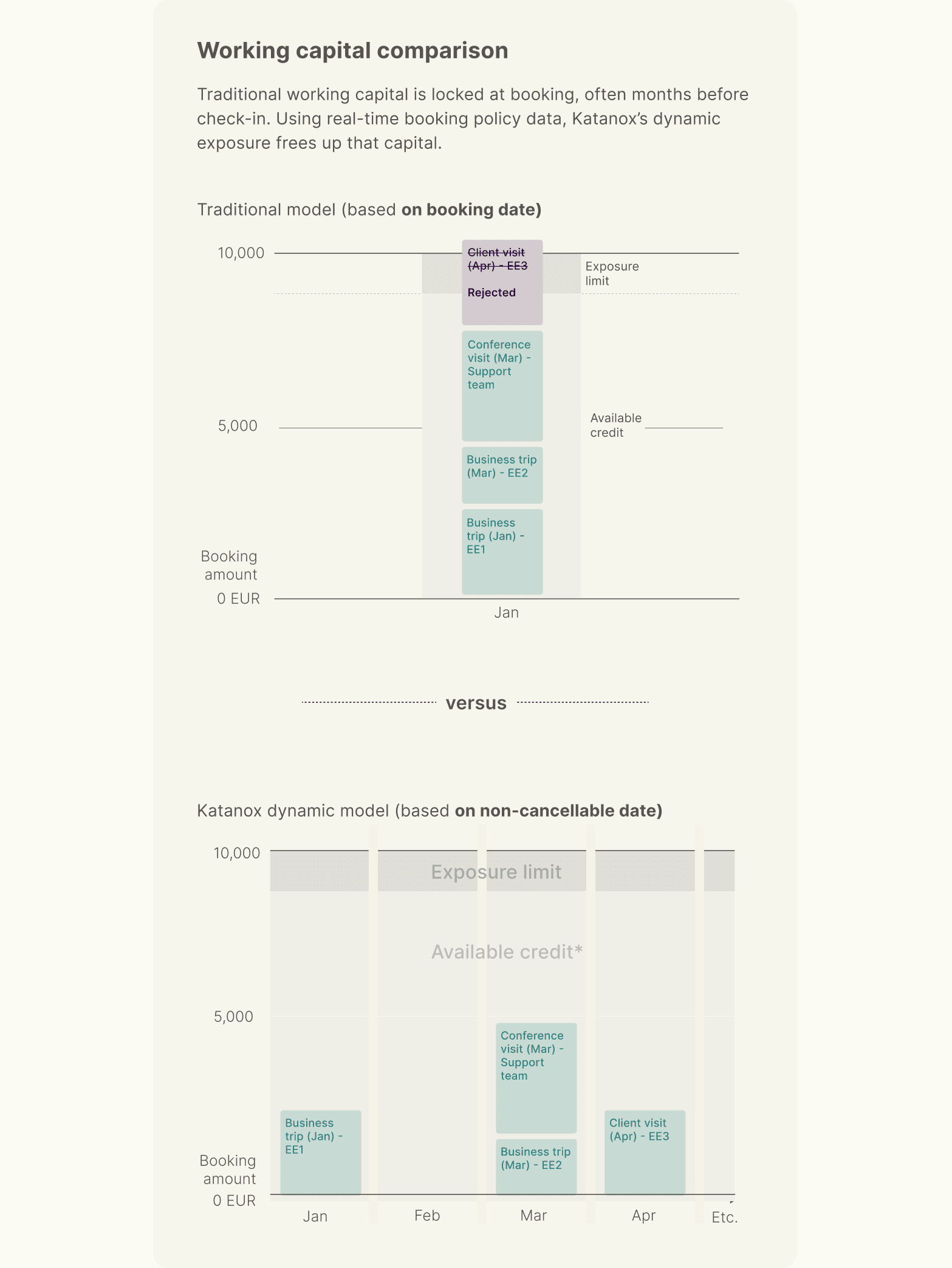
While traditional working capital is locked at booking, the Katanox dynamic model treats each booking as contributing to the total exposure only from the moment of materialization (in this example, which, for simplicity, always occurs at check-in) until repayment occurs.
The system runs a 365-day simulation that accounts for materialization and repayment timelines to ensure no single day exceeds the capital limit before approving new bookings.
Benefits for travel agents and corporate buyers
Travel agents and corporate buyers gain a clear, data-driven view of capital usage and unlock capacity that flexible bookings would otherwise lock under traditional financing measures:
Optimized capital availability for bookings most likely to materialize soon
Reduced exposure to waste tied to refundable inventory
Real-time visibility into exposure and recoverability
More predictable operations during peak periods and volatility
Less manual treasury work through automated, real-time controls
More purchasing power for growth investments
Travel is flexible. Capital should be too.
Flexible policies are now standard in travel, but legacy capital and payment setups were not designed for flexible inventory.
By embedding capital allocation directly into the booking flow and differentiating refundable versus guaranteed reservations, Katanox keeps working capital productive, available, and applied precisely where it needs to be.
This is how finance becomes a growth lever: by reducing trapped cash, improving control, and making liquidity usable when the business needs it.
Imre Vogelezang
Co-founder & CPO
Share