From search to settlement: Why hotels need infrastructure for agentic commerce
Type
"Winning" will depend less on messaging and capturing attention and more on infrastructure: the rails that let a brand sell and service its own product end-to-end.
Imre Vogelezang
Content
This article was originally featured on Hotel Online
For years, hotel executives have worked to shift demand toward direct bookings and away from online travel agents (OTAs). The goals are familiar: stronger loyalty, lower distribution costs, and more control of the guest relationship.
But the next shift in distribution will not be driven by a new website or a new loyalty perk. It will be driven by agentic commerce: AI systems that not only recommend a property, but also execute the transaction end-to-end.
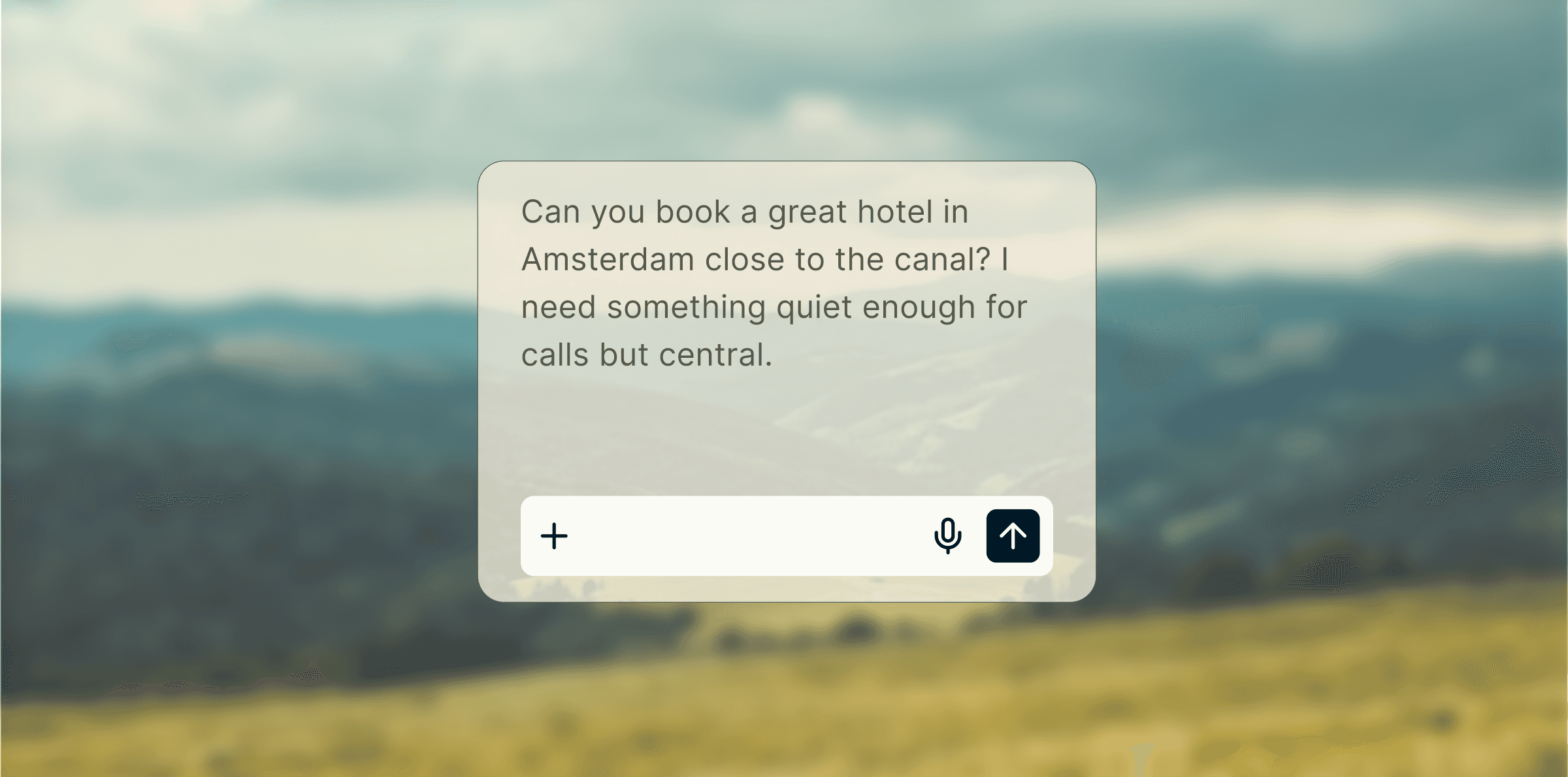
In the near future, a traveler will tell an AI assistant, “Book me a boutique hotel in Amsterdam next weekend,” and the AI will search, choose, reserve, pay, and reconcile in no time.
That creates a better guest experience, but it also brings new challenges. AI platforms could become the next gatekeepers, steering bookings away from brand channels and raising the cost of sale.
So the question for hotel leadership is not whether AI will impact distribution. It will.
The question is: who will control the path from search to settlement, and therefore, who will control the economics of the next era of travel?
A familiar foe in a new arena: the AI interface
Hotels are still battling a familiar foe: OTAs that sit between guests and hotels and charge for access.
What has changed is the arena and the weapons. Attention is shifting from search results and brand sites to AI tools and conversational interfaces. In that environment, distribution power moves from influence and attention to execution.
“As AI agents absorb more of the travel planning workflow, distribution will shift from tools that travelers activate to infrastructure that agents draw on by default,” writes Markus Busch, Editor/Publisher of Hospitality.today.
Busch continues to explain that the ranking logic of AI search currently draws on OTA signals and discoverable structured data, but hotels with a direct, verified data presence will position themselves for a successful agentic future.
AI agents will prefer the booking path that is most reliable, most predictable, and most automated. If a hotel’s systems cannot support end-to-end booking and payment in a way the AI can trust, the agent will route around the hotel and default to whichever intermediary can complete the transaction smoothly.
The new challenge is structural:
The traveler may never visit a brand site.
The booking may happen inside an AI interface.
The AI will choose the easiest rails to transact through.
The most consistent fulfillment wins the demand.
In other words, the next battle for direct is the same battle, but on different terrain.
AI takes more than adoption; it takes execution
Many agentic experiences look seamless in demos, but they break the moment they touch real commerce systems: inventory, payments, fraud controls, and reconciliation. As Adyen puts it in its industry analysis Agentic Commerce Has an Infrastructure Problem, “infrastructure is what’s limiting agentic commerce.”
Many hotel groups are exploring AI through customer-facing features such as smarter search, chat-based service, content personalization, and contact center automation. Those investments matter, but they are not the core requirement for agentic commerce. Infrastructure is that core requirement.
Once again, referencing Adyen’s analysis, the blockers aren’t “model quality” problems — they’re structural constraints in the underlying commerce stack: protocol fragmentation across agent platforms, product data that isn’t built for machine execution, and legacy systems that can’t maintain a reliable end-to-end booking experience through to transaction.
On top of that, trust and liability models for autonomous actions remain unclear.
This is exactly where AI often fails: the moment an agent has to execute in real systems. Agentic systems break down when the underlying stack cannot support autonomous execution.
That usually happens in a few familiar places, and Adyen’s paper makes the same point from the payments layer: what works in a controlled demo tends to fail when it hits fragmented protocols, inconsistent data, brittle enterprise stacks, and trust and fraud constraints.
In travel, that shows up in a few familiar places:
Data inconsistency: Availability, rates, and content are fragmented across systems and do not match in real time.
Operational friction: Changes, cancellations, exceptions, and servicing still require manual intervention.
Payments and reconciliation complexity: Settlement processes are slow, opaque, and disconnected from reservations.
An AI agent can act autonomously only when it can verify its actions, complete the transaction, and close the loop afterward. If it cannot, you do not have agentic commerce. You have a new metasearch version with a conversational wrapper.
This is why “AI strategy” is quickly becoming inseparable from booking and payments infrastructure strategy. The intelligence layer is only as strong as the rails beneath it.
From search to settlement: the real definition of readiness
When agentic commerce becomes a meaningful share of travel demand, hotel brands will need to be ready for the full flow:
Search and selection
AI agents will continuously evaluate options across price, availability, policy, loyalty value, and guest preferences.
For a brand, being competitive here is not just about having the right rates. It is about providing structured, accessible, reliable information that automated systems can understand and trust.
Adyen highlights a similar constraint in retail: product data that was “good enough” for human browsing on a website becomes a hard failure when agents repeatedly query state and need machine-ready schemas.
In travel, the analog is obvious: if content, policies, and “bookability” details aren’t consistent and machine-readable across PMS/CRS/channel layers, the agent will route to whichever pipe can execute reliably.
Booking execution
The AI needs to reserve inventory with certainty. If a booking request cannot be executed cleanly through direct systems, the AI will shift to a channel that can.
Payments and settlement
This is where advantage is won or lost. AI that can book but cannot pay is not finished. AI that can pay but cannot reconcile creates operational risk. Agentic commerce demands embedded, secure, and automated payment capabilities.
This is also where Adyen’s analysis gets very specific about what “autonomy” breaks first: trust, fraud, and liability models were built on the assumption that bots are adversaries, and regulations like SCA/3DS2 assume synchronous human interaction.
As travel becomes more asynchronous and delegated, payment infrastructure must support verified intent, clear liability, and controls that work even when the “user” is an agent.
Post-booking servicing and reconciliation
Real commerce includes changes, cancellations, invoicing, chargebacks, and financial reconciliation. In an autonomous environment, these cannot be slow, manual, or opaque.
Agentic commerce compresses time. The industry cannot rely on batch processes and after-the-fact clean-up while pretending the “guest experience” is modern. The back office becomes part of the product.
The opportunity: agentic commerce can be the biggest direct shift yet
It is easy to frame AI as a threat: new intermediaries, higher distribution costs, weaker loyalty, and less brand control.
But if implemented correctly, AI can actually have the opposite effect.
When agentic systems can resolve end-to-end (not just respond), the upside is measurable. Early benchmarks cited in industry research point to:
15–25% lift in direct bookings
20–25% increase in ancillary revenue
15–36% improvement in repeat bookings
These numbers are not “AI magic.” They are what happens when friction is removed from the full journey — discovery, booking, servicing, and the operational follow-through behind the scenes.
Agentic commerce reduces friction dramatically. It collapses the funnel. That creates a powerful advantage for hotel brands that can transact directly in the agentic flow:
Higher conversion: fewer steps mean fewer drop-offs.
Better first-party data because the brand remains the source of truth for the transaction.
Lower cost of sale by avoiding the economics of intermediated payments and distribution.
Stronger loyalty because the relationship is not outsourced to someone else’s interface.
AI can be a massive opportunity for hotels, but only for those that can participate in agentic booking as a direct channel, not as a supplier to an intermediary.
Early use cases
Numerous early use cases are already emerging, underscoring both the traction and the potential of AI in travel. Let’s look at a few examples that illustrate this shift.
One early indicator is Marriott’s recent direct-booking integration with Google’s “AI Mode.” Notably, Marriott, after previously flagging AI as a strategic risk, now signals a more open stance by collaborating with Google, which positions itself as a utility layer that captures intent and routes travelers directly to the brand.
Travhotech’s breakdown makes two implications especially concrete:
Google is becoming the booking “utility,” prioritizing speed and intent resolution, while Brand.com remains the place hotels must deliver the experience and handle complexity.
If it isn’t digitized into machine-readable assets, it becomes invisible to AI-driven discovery. That pushes hotels to expose not just rooms, but dining, spa, and other on-property experiences as structured, transactable inventory.
A second signal is Wyndham, which has outlined a pragmatic “connect to the interfaces” approach across multiple LLM platforms.
Based on details shared on its Q4 2025 earnings call, Wyndham is:
Partnering with Google on an agentic booking experience in AI Mode to enable seamless direct bookings inside the AI experience.
Connecting to Anthropic’s Claude to offer conversational search (currently linking out to complete the transaction on brand.com).
Working with Mobi to power intent-driven travel search on ChatGPT, with bookings via Wyndham expected in Q2 2026.
Wyndham’s CEO described the integration effort as modest (under $100k to connect its MCPs to LLMs), while also emphasizing the value created by AI-enabled guest messaging and voice assistants, which can reduce front-desk workload and drive incremental upsells for properties.
One caution from Adyen’s report maps cleanly here: today’s integrations are still largely “pilot economics,” dominated by enterprises with dedicated engineering teams.
Without a scalable onboarding model (where one integration works across agent platforms), the ecosystem remains stuck in bespoke projects, and that is exactly when intermediaries that abstract away fragmentation tend to gain leverage.
This is the pattern that matters for agentic commerce readiness: not just “using AI,” but wiring distribution and operations so agents can reliably discover inventory, execute bookings, and hand off cleanly to direct systems.
Together, this shifts distribution less toward traffic acquisition and more toward machine-readable inventory, digitized experiences, and a booking flow that can execute reliably end-to-end (including payment processing) without an expensive intermediary.
What “owning the rails” looks like
To seize the opportunity, hotel leadership teams need to treat infrastructure as a strategic asset. Four capabilities matter most:
1. Understandability: structured data
AI agents need machine-readable, verifiable information—such as availability, rate rules, policies, and identity—delivered with deterministic behavior and real-time accuracy. When data is inconsistent, agents fail—and in travel, failure breaks trust. This is the foundation: a harmonized layer that makes inventory and rules reliably understandable to machines.
2. Transactability: embedded payments
The “magic trick” of the agentic future is that discovery, booking, payment, and servicing occur in a single continuous experience. If payments are bolted on through slow, manual, or disconnected processes, the experience breaks, and intermediaries will win by offering a cleaner transaction layer.
3. Reach: cross-assistant activation/interoperability
Connecting to a single assistant isn’t a strategy. If each AI surface requires a bespoke integration—or if the booking path changes by assistant—you recreate the OTA problem in a new form: fragmented execution, brittle handoffs, and higher failure rates. The goal is a portable activation: a single stable integration pattern that works across assistants and protocols.
A stable infrastructure lets brands participate across AI surfaces without switching rails or losing state—so an agent can move cleanly from search → booking → payment → settlement, without introducing reconciliation risk.
4. Operability: automation, risk, reconciliation at scale
Agentic systems will generate high volumes of requests, changes, and transactions. Hotels need infrastructure that can handle this with low latency, clear verification, risk scoring, and reconciliation, so autonomy does not create fraud exposure or financial chaos.
Katanox’s role is to provide the underlying financial and distribution backbone that enables agentic commerce: a harmonized layer connecting reservation and financial systems, enabling real-time verification and reconciliation, and a predictable interface that reduces inconsistencies and prevents failures.
In an agentic world, “direct” means controllable
AI will change the front door of travel. Guests will increasingly start with an AI interface rather than a search engine or a brand homepage.
That does not mean hotels have to lose. But it does mean the definition of direct evolves. In an agentic environment, direct is not only a channel. It is a capability:
Owning the connection.
Owning the data.
Owning the flow of payments.
Because, in the end, the winners will not be the hotel brands with the flashiest AI demos, and certainly won’t be the ones fighting AI. The winners will be the companies that can reliably and at scale take a booking from search to settlement on infrastructure they control.